DR JAMES LAMB
  • About
  • Publications
  • BLOG
  • About
  • Publications
  • BLOG

University crest

16/4/2013

0 Comments

 
This is just a note to revisit an earlier idea a had, which I was reminded of during Ray Land's presentation at the e-Learning@edinburgh conference last Friday. The following is drawn from my own notes taken during the presentation:
The universities were the printing presses of their time. That’s why they have books as a coda in their crests. Harvard include ‘truth’ as in truth is in the bound book. However Harvard now has the logo as part of a strapline that includes digital innovation, recognising that it’s not just the bounded book.
I could acknowledge Land's view here, making the point that the development of the Harvard university crest can be seen as representing the way that the book is longer the sole means of learning - it is part of the digital educational landscape. 

I wonder whether I could include this as part of a discussion of how university crests might be reimagined to reflect the multimodal nature of learning. I touched on this within my EDC assignment. This could come within the historical section of my literature review. It needn't be lengthy.

I could make the point that the Land draws our attention to the Harvard University crest as a recognition of the way that the digital influences our learning resources. The historical dominance of the bound text within higher education can be seen in the presence of books within university crests of the ancient mediaevel Western Universities. But as the digital has reshaped learning so these crests have been altered to reflect the new ways. Up to this point I'm not saying anything new. However I could move beyond this to suggest that the visual strapline accompanying the old crest implies  could be seen as reflecting the continued dominance of the book, or perhaps a reticence to move away from the certainties of traditional authorship and learning. Perhaps in the future the university crest itself might truly embrace multimodality with a visual representation of new ways of communicating ideas. Nevertheless, the proposed shift from page to screen is sometimes acknowledged, but not genuinely reflected symbolically in crests.

Hmmm. Is this appropriate for the literature review. I like the idea but maybe I'm wandering off towards speculation?
0 Comments

Response from Stephen Hunter re. observation

16/4/2013

0 Comments

 
An e-mail conversation with Stephen Hunter from Intermedia art this afternoon:
The hand in for 3rd Year students here is 8th May, I think. No firm date for when this will assessed but quite soon after that.

I have some with First Year students next Tuesday, 23rd, though I'd be concerned about having an observer, as it's the students' first experience of this, and I can imagine they'll be quite nervous. I'll check for other
years. 

Bye the bye, I was talking to my Mum on Sunday. She was involved in some research projects at Moray House, led by Martin Colvill,  in to Deaf education. She was telling me about IQ test they used, that didn't involve
English and was purely visual. They tested it on both Deaf children and hearing, ages 4-15 years. I'd imagine you know about it already, but thought I'd mention it.
So, there's still the possibility that I might be able to observe Intermedia Art taking place and also the subsequent assessment of the student's work.
0 Comments

IDEL reading list from Jeremy

16/4/2013

0 Comments

 
Jeremy has been kind enough to respond with the requested reading list for the relevant section of the IDEL course, as follows:
Core

Fitzpatrick, K. (2011) The digital future of authorship: rethinking  originality, Culture Machine vol. 12.

Additional

Goodfellow, R. (2011) Literacy, literacies and the digital in higher education. Teaching in a higher Education 16(1) pp.131-144

Landow, G (2006) Hypertext 3.0: Critical Theory and New Media in a  Global Era (Baltimore: Johns Hopkins University Press) extracts:  278-291 and 302-309

Lea, M. and Jones, S. (2011) Digital literacies in higher education:  exploring textual and technological practices. Studies in Higher  Education 36(4) pp.377-393

McKenna, C. and McAvinia, C. (2011) Difference and discontinuity:  making meaning through hypertexts, in Digital differences:  perspectives on online education, Ed. Bayne, S. & Land, R., pp. 45-60,  
Rotterdam: Sense Publishers
All of the names here are familiar and I think I've read most of the resources on the Additional list. The Fitzpatrick however is new to me and was also recommended by Sian at our last meeting, so that's useful. 
0 Comments

Ray Land at elearning@edinburgh conference

13/4/2013

0 Comments

 
I'm indebted to Marshall for making me aware of yesterday's Conference. In particular, Ray Land's presentation was directly relevant to my research as it touched on digital scholarship, the history of texts in Western universities, multimodality and other themes. Here are my frantically-typed-at-the-time notes:
ray_land_elearning_conference_april_2013
File Size: 108 kb
File Type: ray land elearning conference april 2013
Download File

I've e-mailed Marshall this evening to see whether I can get a copy of the full slides from his presentation.

Meanwhile, I've had a look at Ray Land's profile on the Durham University website and includes his publications list:

Picture
http://www.dur.ac.uk/education/staff/?id=10278
One of my tasks for this week will be to go back and reflect on some of the themes he touched on and consider how they might inform my lit review or research in general.
0 Comments

Multimodal Glossary

13/4/2013

0 Comments

 
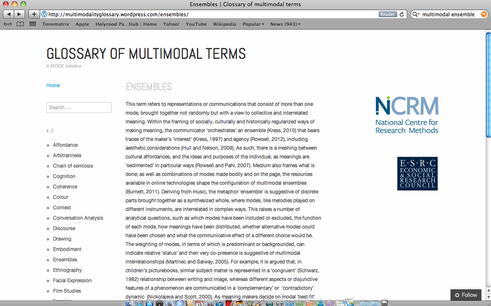
I came across this potentially useful resource today:
Picture
It looks like a nicely prepared document, perhaps even a lit review. I'll come back to this later on.
0 Comments

eLearning@ed conference

11/4/2013

0 Comments

 
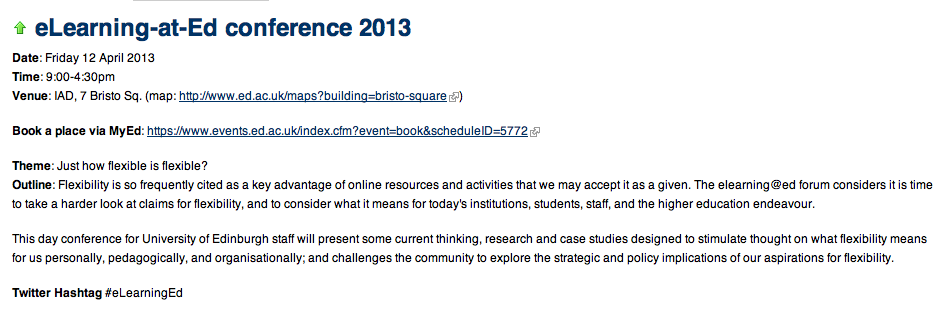
I'm attending this conference tomorrow:
Picture
Which will include the following potentially valuable session:

Picture
I've e-mailed Ian in advance to say that I'll make a point of introducing myself, after we failed to find a time to meet up earlier in the term. 

Also, Sian will delivering the following session which I don't imagine will be of direct relevant, but will be interesting all the same:

Picture
0 Comments

Notes from meeting with Sian on 5 April 2013

11/4/2013

0 Comments

 
I've been a bit slow on this. Here are the notes from last week's meeting with Sian where we discussed my second draft lit review, dissemination, data analysis and a few other bits and pieces.

Some general comments:
  • Really well written
  • Nicely critical
  • Done a great job on affordances – managed to say a lot in a short space
  • Thorough
  • Nicely structured
  • Basically, it’s great and I should feel really good about it. It reads like a piece of scholarly work.


Gaps, weaknesses and room for improvement:

  • There’s nothing on print dominance including the history. There is an identifiable print dominance in education. This needs to be acknowledged in my exposition section. If I’m going to make the point that it’s not all about print, I first have to recognise that it is significant. There’s a gap otherwise. What is essayistic linearity? Reshaping academic composition from what?
  • Also in terms of historical context, maybe I need to talk in more detail about the way that texts were multimodal.
  • I need to have more about the characteristics of multimodal text. What does multimodality do to text? This is what it can be like. I’ve only touched on authorship and there’s room for more.
  • How have other people looked at how we assess multimodal artefacts? There might be some stuff out there. Worth looking for this, though. This should go within the ‘decomposing artefacts’ section.
  • I need to write more directly in relation to my own research. At times it’s like I’m shying away from it. It’s OK to write directly – and in the first person – about the research project and questions within the lit review. I’m situating myself as a researcher, not aspiring to be objective – I’m doing some more interpretative.

Fitzpatrick?

  • Is it worth looking at other examples of multimodal literature e.g. Darius Glass, Alisdair Gray, Tristam Shandy? I could maybe use screen shots.
  • The dissertation form should reflect the content. Ideas should be presented in a particular way for a reason. For instance, there needs to be some significance to the use of soundtrack, even if it might take the reader some time to work it out.
  • Is it risky to go for multimodal dissemination? No, it’s essential to present ideas multimodally considering my topic. Have a look at Matthew Preston’s web essay from IDEL a few years back (it will be on course gallery). Incorporates music. 
  • Considering there are relatively few interviews, investing time in Dedoose might not be worth the effort as its purpose is to deal with data collaboratively. It also costs.
  • Hyperresearch might be a better option than Dedoose, but maybe I should just use MS Word with hyperlinks for transcription.

Things to leave out:
  • Stick to summative assessment frameworks, rather than trying to cover formative and summative.
  • It’s OK to leave out the counter-linguistic turn due to lack of space
  • Don’t go into digital authorship unless it’s a major theme

0 Comments

Constellation image for dissemination

11/4/2013

0 Comments

 
Over lunch, some quick thoughts on the constellation image to go on the front cover of my web essay for dissemination.

The front cover will be dominated by an image.
The image will depict a study-related scene.
The study-related scene will include a range of different artefacts.
Each artefact will represent a different section of the web-essay.

The pictured artefacts could include the following:
a pile of books to represent references
a camera including printed out photographs (of ECA observation) to represent observation
a Skype interview on screen to represent data collection

Other sections of the essay that will need to have a depicting image, including:
introduction
methodology
background
discussion of findings
conclusion

Other study related artefacts within the image could include:
CDs, ipod etc to represent the sound element. Maybe a CD that matches the nature of the research
pens, pads, post it notes and other study-related tools
coffee mug. Perhaps there's a Penguin mug that matches the subject matter.
an assessment handbook

Some other thoughts:
the depicting image will also appear as a signifier at the top of each page
images will also be used at the bottom of each page for navigation
I imagine the image being realised in grey and white with a constellation over the top of it
it will be interesting to think about whether the image could be created in another application and embedded into the html of the page, in a way that would enable particular hot spots or text to appear - could I embed a thinglink with links to the different pages of the web essay?

I like this idea.

0 Comments
Forward>>

    Categories

    All
    Abandoned Ideas
    Abstract
    Acknowledge And Bib.
    Actions/things To Do
    Appendix
    Brian Eno
    Carey Jewitt
    Conclusion
    Constellation Map
    Data
    Data Emergent Ideas
    Digital Spaces
    Dissemination
    Dissemination Rationale
    Eca
    Ethics
    Fitzpatrick
    Glossary
    Hypertext Links
    Ideas
    Image
    Interviews
    Kress
    Land
    Literature/reading
    Lit Review
    Meetings
    Methodology
    Music
    Natasa Lackovic
    Observation
    Photography
    Research Proposal
    Sian
    Soundtrack
    Stephen Hunter
    Time Needed For M
    Title
    Uni Crest
    Vectors
    Video
    Visual

    Archives

    October 2013
    September 2013
    August 2013
    July 2013
    June 2013
    May 2013
    April 2013
    March 2013
    February 2013
    January 2013
    December 2012
    November 2012
    October 2012
    September 2012
    August 2012
    July 2012
    June 2012

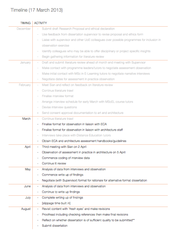
    Timeline

    Picture
    Other stuff
    Resources page
    Moodle
    EDC13
[email protected]