|
Over the weekend, Sian was kind enough to take time to discuss my (lack of) progress on the dissertation. This subsequent e-mail is a pretty good record of where we left things:
"Hi James I'd hoped to get a chance to touch base with you on this f2f but didn't manage it today. My understanding of the situation is that you are currently considering two possible areas of research: 1) something around 'feedforward' and multimodality 2) something around multimodality and alternative forms of academic writing (possibly specifically within the context of policy at UoE) I'm not quite sure where we left it in terms of supervision, so here's my view. 1) If you want to research feedforward, Dai would be an excellent supervisor for you (I would worry a bit that he wouldn't be able to give you a lot of time, but suspect that once you have your direction you may not need too much 'hands-on' supervision) 2) If you want to research multimodal assessment and/or policy from within 'visual' ways of understanding, and of methods, you would be better supervised by me as it's one of my own research areas. I'm sure there are other options here in terms of topic, which I'd be happy to discuss with you any time. Either way, I'd like to help get things moving for you, so please just let me know where you'd like to go with this next. all the best, hope you had a good journey home, Sian"
0 Comments
As always, a useful meeting with Clara this afternoon. As always some valuable to-the-point feedback. In Clara's view my proposed plan was interesting but a bit boring. Instead we talked through how I might make it more interesting and exciting as piece of work. Perhaps the relationship between feedforward and multimodality could be the missing element to turn a somewhat dull idea into an interesting one. Basically, I need to be more creative and imaginative.
How multimodality shapes feedforward and how feedforward can shape multimodality. The relationship between the two. The literature review could go something like. Begin by acknowledging how pedagogical and technological developments are changing the nature of online assessment. Go on to say that assessment is a form of creative crisis (as per the manifesto project). Highlight the fact that there has already been some work on multimodality in assessment. Then go on to say how there has also been some discussion of how multimodality impacts upon feedback practices. Follow this up by saying that the relationship between multimodality and feedforward has been under-researched and therefore an opportunity exists to add to the discourse on this subject. How does multimodality make us think about feedforward. Or maybe I should ask how does multimodality encourage us to rethink feedforward. This would be a piece of action research. Using the literature, I would devise a system of multimodal feedforward that would be implemented to an existing course. I would develop the method of feedforward. It could be audio feedforward, for instance. The proposed plan would be rooted in literature. It would be put into practice within a course. I would then observe how it worked in practice. This would involve observing the use of feedforward and/or peer feedforward. Research questions could be: Is it effective and how effective is it? Or is it about other things such as peer relationships and conneurship. Timing-wise, it would be unrealistic to aim for a January course - it's too soon. Better instead to aim for a course beginning next September. An alternative might be to look for a summer course. It might be difficult to demonstrate how the proposed method of multimodal feedforward would impact upon marks. There might also be ethical issues with viewing student's marks. An alternative might be look at the Academic Writing course that Christine Sinclair runs. There are a number of advantages to this. I know Christine. I know the course. There's an argument that it might be easier to get approval for a course of this kind where assessment is not linked towards grading or subsequent progression through a programme. There are potential weaknesses however. The course might be too short to observe any impact of my proposed approach. An alternative might be to use my connection with DEI to identify a willing course programme. A potential downside to this however would be that, in my opinion, programme leaders might be less willing to 'experiment' in an exercise that is linked to formal assessment. Furthermore, I don't know any programme leaders and I would be therefore putting my trust - and the jeopardy of my project - in the hands of someone unknown to me. I would need to go back to multimodality to demonstrate my understanding of what this means. Tutors in art and music already work with multimodal work. In terms of feedforward, the crit offers an interesting example. Feedforward hasn't gained the traction that it should have therefore this has value and currency in terms of its practical professional application. In Clara's view, if I was to follow this route it might be possible to get Dai Hounsell to act as a co-supervisor which would clearly be valuable. It might also contribute to a piece of work that would be closer to publishable. Here: 
I bookmarked the release of the this publication - The SAGE Handbook of Digital Dissertations and Theses - during the summer. At that point I wasn't considering multimodality and feedback as the focus of my dissertation. 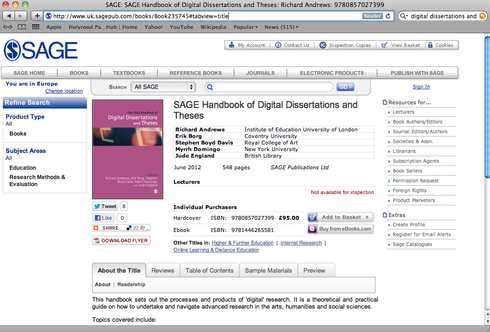
http://www.uk.sagepub.com/books/Book235745#tabview=title
This evening I've revisited the dissertation guide and have extracted the key information explaining what it expected within the exercise. Perhaps the most useful information comes at the end within the Course Summary section, where it is explained exactly what the point of the dissertation. And here's the edited original: A couple of thoughts, based upon the idea of exploring tutor experiences of alternative format assignments:
Phase 1: Online survey I could prepare an online questionnaire survey to be distributed amongst tutors on online programmes with the University. Perhaps I could get the DEI seal of approval to encourage participation. This could ask whether tutors had experience of marking assignments submitted in alternative formats. It could ask the different formats they had come across. And other things. It could have a tick box where participants could indicate if they would be willing to participate in an interview. The questions within the survey could emerge from the literature or discussion with my dissertation supervisor and perhaps others who have experience in the area. A pilot questionnaire could be tested on fellow e-learners who are involved in online tutoring. One of the aims of the online questionnaire survey would be to identify themes for discussion during the interview stage. Phase 2: Interviews I could conduct online interviews with course tutors. Using the data collected from the first phase I could identify tutors who indicated they have encountered alternative format assignments. I would also presumably need to look at a range of courses? The nature of the questions to be explored would be based upon themes to emerge from the questionnaire data as well as from the literature. These interviews would look to explore themes in more depth, but also to test some of the ideas proposed in the theory. Is the experienced reality the same as what it proposed in the literature? How do some of the approaches recommended in the literature (in terms of alternative feedback) work in practice? The interviews would be semi-structured - some pre-determined questions and prompts, but with space for the interviewees to shape the discussions. Some ideas I jotted down earlier today for the dissertation title. I think I'll ditch the 'multimodal assignment in favour of 'non-traditional digital assignment':
'Responding to the multimodal essay: what are the implications for online tutors of the non-traditional digital assignment?' 'Responding to the non-traditional digital assignment: experiences of online tutors within a UK university' 'Responding to the digital essay: experiences and attitudes of online tutors to non-traditional assignments' 'Responding to the digital essay: how online tutors provide feedback on non-traditional assignments' 'Responding to the digital essay: how can online tutors provide feedback on non-traditional assignments' 'Responding to the digital essay: assessment and feedback experiences of online tutors' 'Responding to the digital essay: how online tutors assess and provide feedback on non-traditional assignments' 'Responding to the digital essay: experiences of online tutors involved in assessment of non-traditional assignments' Actually, perhaps 'alternative format assignment' is a better term than the awkward non-traditional digital assignment? 'Responding to the digital essay: experiences of online tutors involved in assessment of alternative format assignments' 'Responding to the digital essay: experiences of alternative format assignments amongst online tutors within a UK university' 'Responding to the digital essay: experiences of alternative format assignments amongst online tutors within a UK university' 'Responding to the digital essay: staff attitudes towards alternative format assignments. A study of the experiences online tutors at a UK university.' 'Responding to the digital essay: staff attitudes towards alternative format assignments. A study of the experiences online tutors at a UK university.' Technological advances and pedagogical innovation are helping to reshape the online classroom. In particular, the potential exists for students to express ideas in new ways. Armed with a growing array of digital tools, online students can exploit different modes in the preparation of coursework assignments. Podcasts, films, web essays and digital dissertations now complement or even replace the traditional text-based essay. In some cases, a single essay might present ideas in oral, textual and visual form. The online classroom is being reframed as a place of multimodal learning populated by transliterate students.
While this multimodal classroom provides exciting new ideas for the dissemination of ideas, a shift towards the presentation of work in non-traditional digital formats inevitably has implications for online teaching and feedback. As the online classroom evolves, so there is a need for tutors to adapt to these new modes of communication. Tutors face the challenge of assessing the quality of academic work that is presented in non-traditional formats. We may need to rethink the assessment criteria that have been used to express words on screen or page. How do we apply standards of academic rigour to a build in Second Life or a hypertext essay? And beyond how the tutor actually assesses the non-traditional assignment, is there a need to rethink the format used to provide feedback - is it appropriate to use textual feedback to comment on an assignment submitted as a podcast? In this dissertation I will:
Some positive news. Clara has kindly agreed to meet up next week to talk through a dissertation idea I've been giving some though to. In fact it was Clara who helped to spark the idea during a conversation about online assessment and multimodality a few weeks ago. I've been playing around the idea since then, trying to consider whether and how it would make a valid subject for dissertation research. It will be great to get Clara's (honest and clear) feedback on my idea when we meet up next Friday 12 October at 2pm.
Before then, I'll need to work out how to make best use of Clara's time. This means arriving at the meeting with a carefully considered, researched and rehearsed plan. This isn't a case of trying to 'sell the idea', more a case of really ensuring that I'll be in a position to put my ideas across clearly. Also, by taking time to think through the ideas I'll be able to identify weaknesses and questions for myself. In practical this will involve:
Once I've done all of these thing, I think it will also be useful to write down what I hope to take from next week's meeting. Thinking and planning are all well and good, however I think it's time to do some reading in order to come up with a focused topic for my dissertation. I'm going to begin by revisiting the content of the Online Assessment course and take it from there. Hopefully something will come out of that. Not quite sure when I'm going to do the reading - I've grabbed a ten-minute window to some writing but need longer to do to read an academic paper- but I'll need to get it going soon. Friday afternoon is the next opportunity - I'll need to protect that time.
|
Categories
All
Archives
October 2013
Timeline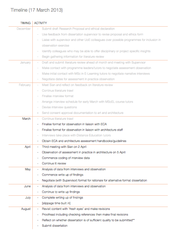
Other stuff
|
||