DR JAMES LAMB
  • About
  • Publications
  • BLOG
  • About
  • Publications
  • BLOG

A summary of Michael's valuable lit review tips

26/12/2012

0 Comments

 
Following Michael's generous e-mail, I've summarised the key bits of advice he recommends with regard to my lit review:
  1. Consider defining multimodality
  2. Avoid conflating multimodality and transliteracy (or multimedia)
  3. Find an article that nails it for my research, and work backward and forward from there. The McKenna chapter for instance might be perfect.
  4. With the foundation article selected, visit Google Scholar and do the citation search for that article. It will take me to people who have cited that article and I can look for similar, relevant work.
  5. Look through the reference list on the foundation article and follow those up. 
  6. Do some straight up searching, although this might have mixed success depending on the search term I use. This might require a whole slew of searches. Multimedia and assessment might be the best search terms.
  7. Set up Google scholar alerts so that when new relevant material is published, I will hear about it.
  8. Be surgeon like in considering articles for inclusion. Unless it is directly relevant, ditch it. Don’t venture of task for a moment. It will waste the word count if nothing else.
0 Comments

Michael replies...

26/12/2012

0 Comments

 
When I e-mailed Michael just before Christmas I didn't expect an immediate response, and I certainly didn't anticipate that he would have gone into so much thought and detail. I'm going to post his full response below before working through the different items:
Hello there, James,

Great stuff on the research proposal. Enjoyed it and it is fun to see someone with such similar interests as mine. I am less on assessment but we share an equal fascination with unconventional modes of representation. 
  1. I am attaching your research proposal with some notes attached. Great stuff and most of my comments are minor. I might consider at some point defining multimodality (as championed by Kress) and transliteracy (more of the McKenna camp). Kress is at IoE and has this weird mythical following and my supervisor has strongly cautioned me to avoid conflating multimodality and transliteracy (or even multimedia). My notes explain on this a bit. I would go with whatever Sian says, though and I think she uses multimodality. 
  2. As for Literature Review (which I am doing now for the PhD so that is a nice coincidence), depending on the day I am quite systematic or quite serendipitous in my searching. Here are my tips as I see them. 
  3. I think the trick for me has always been to find that one article that absolutely nails it for your research and then work forward and backward from there. I think for you that McKenna chapter is fantastically apt as she makes the case that these hypertext essays (same thing as what we are talking about-multimedia) are advancements and assessable and all that. So, that chapter (perhaps much more than Kress) might represent the foundation for your research. 
  4. From there, I would go to Google Scholar, find that McKenna chapter (or anything similar she might have written) and then citation search that. This is quite easy on Google Scholar as they provide a link for every search result that says Cited by..... Click on that and you will see anyone that has cited this work for their research. Chances are the one that cited is awfully similar to it. See attached screenshot (and below)for that Cited by link. This is basically reverse citation engineering. 
  5. Go back to the McKenna chapter (or whatever you choose) and go through her references for background. This stuff is invaluable for your lit review as it is basically evidence of someone establishing the heavy hitters in this space for you. I am not condoning plagiarism or anything like that, but nor do I feel it necessary to reinvent the wheel. McKenna writes a lot about multimedia so her background research would be perfect for your lit review (along with some assessment mechanisms, which I think she writes about as well). 
  6. When you have exhausted these tasks, it is down to straight up searching, but this is problematic as not a single author has agreed on the terminology for "multimedia essay". So, you basically have to do a whole slew of searches (with quotation marks to establish the phrase and not the term) for a. "hypertext essay" assessment b. "multimedia essay" assessment c. "digital essay" assessment and on and on. I think to begin with your best bet is multimedia and assessment as search terms and work from there. 
  7. I think rather than type these again and again, set up Google Scholar Search Alerts as these will alert you when new articles are published that fit your criteria. Helpful. The Create Alert link can be found at the bottom of each search results page on Google Scholar. 
  8. More than anything with the dissertation I found was the tendency to write too much rather than not enough (the word limit is quite restrictive). So my advice is to be surgeon-like in reviewing these sources. If something doesn't relate to multimedia, literacy, or assessment, then dump it. Don't venture off task or focus for a moment (I got pinged for this). So this is also why I caution on using Kress and multimodality except for supporting accounts on why alternative forms of knowledge construction are so important. You could spend decades getting lost in that Kress maze. He is great for stressing that new modes of communication are important, but not necessarily practical uses for these new modes (or assessment mechanisms). He is really into socio-linguistics and social semiotics and that is a confusing realm. So use him, but mostly as supporting evidence on new modes of meaning making. Not as your analytical theory or framework or anything. Just my two cents. We can talk on the phone more about this if you want. 
  9. I am going to send you in a separate email some articles I use. Better yet, do you use Dropbox? If so, I have all my research in nice little folders and I would be happy for you to peruse them as you need to. Full articles, etc. No point in going through my pain. If you have a Dropbox account, let me know; otherwise I can just invite you. Really cool tool for sharing/collaborating. All my research is just sitting there for you to look through if you want. Here is the link but let me know what email address you want to use for Dropbox and we can share a bit easier. https://www.dropbox.com/sh/8wmxnrt13b0x87c/Zsigqs-chR. 

Awesome stuff, James! So excited to see your topic and what you are pursuing. I won't lie to you, I wish I was working with Sian as well. She is a joy to learn from. 

So go ahead and review and get back to me with questions and we can discuss. Happy to help my man! Merry Christmas!
As ever, fantastic (and fantastically generous) stuff from Michael. To make best use of his tips I'm going to summarise them now in a separate post.
0 Comments

Kress (2006): Gains and losses

13/11/2012

0 Comments

 
Once again, from one of my EDC10 binders of readings. Cited text from the paper indented, followed by my comments in each case.
"The current home page is profoundly different. It is not organized following the logic of the traditional written page but following that of the image-based logic of contemporary pages. Tellingly and more significantly, this page has thirteen distinct entry points where the 1992 page had one." (p9)

and

"It was an entry point given by convention and used by the author. Access to the power of authorship was strictly governed." (p9)
Comment:
"The existence of the different entry points speaks of a sense of insecurity about the visitors, a feeling or fragmentation of the audience - who are no longer just readers but visitors a quite different action being implied in the change of the name." (p9)
Comment:
"This then leaves the task of finding principles that will show the 'affordances', distinct potentials and limitations for representation of the various modes." (p12)
Comment:
"Sequence is used to make meaning; being first has the potential to mean something other than being second or being last." (p12)

and

"Sequence has effects for authorship and for reading." (p13)
Comment:
"Speech and writing tell the world; depiction shows the world. in the one, the order of the world is that given by the author; in the other, the order of the world is yet to be designed (fully and/or definitely) by the viewer." (p16)
Comment:
"The new constellation of image and screen - where screen, the contemporary canvas, is dominated by the logic of image..." (p18)
Comment:
"Where with traditional pages, in the former semiotic landscape, it was the power of the author that rules, here, it is the interest of the reader, derived from the contingencies and needs of their life-worlds." (p18)
Comment:
"The new media make it possible to use the mode that seems most apt for the purposes of representation and communication." (p19) 

and

"I can now choose the mode according to what I know or might imagine is the preferred mode of the audiences I have in mind." (p19)


Comment:
"That certainty is gone; each occasion of representation and communication now becomes one in which the issue of my relation to my audience has to be newly considered and settled on." (p19)
0 Comments

Carpenter (2009): Boundary negotiations

13/11/2012

0 Comments

 
Some great stuff in this article that I first read for the EDC10 course. Cited text indented, followed in turn by my comments.
"...students enter composition classrooms already possessing technological skills that often surpass those of their teachers." (p139)
Comment:
"Students read and construe meaning from cultural products in complex, nuanced ways. employing a wealth of strategies gained from years of immersion in media-rich environments." (p139)
Comment:
"We have had to expand, if not outright revise, our notions about text, literacy, reading, composing, authorship, intellectual property, argument, research, learning space, plagiarism, assessment, and a host of other concepts." (p140)
Comment:
[Cites Catherine Hobbs (2002:27)]: "Writing teachers today are living through a revolution in literacy."
Comment:
"Texts composed in or for electronic environments have little in common with that bastion of academia, the traditional academic essay." (p140)
Comment:
"...responses to inquiries regarding electronic texts and academic literacy usually resort to a reliance of the traditional standard of academic classification and clarification: comparative analysis of textual features and forms." (p141)
Comment:
"Texts can be recast from containers or receptacles to processes and practices that operate within, between, and among networks of social networks."

and

"Freed from the frustrating constraints of form and content, electronic texts can be considered on their own grounds, in their own environments..." (p141)
Comment:
"These interactions, coupled with the powerful and innovative ways of composing and communicating allowed and engendered by new technologies, have in turn caused new kinds of writing and texts to emerge and evolve." (p143)

and

"...a seemingly endless variety of tools-in-use." (p143)
Comment:
"In response, Trupe compared the characteristic features of the traditional academic essay with those of an electronic text." (p144)
Comment:
"But a skilled writer in any medium is reflective and analytical, understanding that texts are meaningful, or produce meaning, through the mediation of genres, old or new, that are always already socially constructed and rhetorical." (p145)
Comment:
"As scholars have long pointed out, students may have developed electronic literacies through frequent immersion in digital environments and systems, but that does not mean they possess critical literacy skills as well." (p146)
and

"Additionally, some scholars have pointed out that technological literacy is not the same thing as critical technological literacy (Selber, 2004; Duffelmeyer, 2000)." (p146)
Comment:
"As new and emerging technologies continue to alter writing practices and pedagogy (not the mention the landscape of education in general), it is crucial that students and teachers alike expand their notions of literacy." (p146)
0 Comments
Forward>>

    Categories

    All
    Abandoned Ideas
    Abstract
    Acknowledge And Bib.
    Actions/things To Do
    Appendix
    Brian Eno
    Carey Jewitt
    Conclusion
    Constellation Map
    Data
    Data Emergent Ideas
    Digital Spaces
    Dissemination
    Dissemination Rationale
    Eca
    Ethics
    Fitzpatrick
    Glossary
    Hypertext Links
    Ideas
    Image
    Interviews
    Kress
    Land
    Literature/reading
    Lit Review
    Meetings
    Methodology
    Music
    Natasa Lackovic
    Observation
    Photography
    Research Proposal
    Sian
    Soundtrack
    Stephen Hunter
    Time Needed For M
    Title
    Uni Crest
    Vectors
    Video
    Visual

    Archives

    October 2013
    September 2013
    August 2013
    July 2013
    June 2013
    May 2013
    April 2013
    March 2013
    February 2013
    January 2013
    December 2012
    November 2012
    October 2012
    September 2012
    August 2012
    July 2012
    June 2012

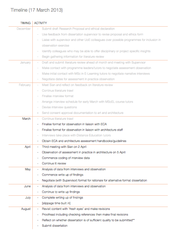
    Timeline

    Picture
    Other stuff
    Resources page
    Moodle
    EDC13
[email protected]