|
A not particularly convincing thought that I had on the way home this evening:
How about including a visual of the multimodal university crest within the lit review, rather than just talking about it. After all, this is intended to be a multimodal artefact, therefore when proposing that the digital university in the future might need to rethink its crest, why should I stop at text? Certainly, this isn't conventional. But then the dissemination itself is following a non-traditional route therefore why not? It needn't be a significant focus of discussion, however maybe when proposing such a crest, maybe I have the image embedded into the section of text. It would be pretty obvious what I'm talking about therefore I wouldn't need to really explain in any great detail what's going on within the graphic. In fact this raises a wider and interesting point: how much use should I be making of images within my text? Thus far my thinking has simply been along the lines of 'signifier' images at the top or bottom of pages. But surely I'm missing something here. Should I not have images punctuating the text through the document (or at least, certain sections where it lends itself to that kind of thing)? This feels like a significant issue therefore I going to explore it within a dedicated blog post to follow. Meanwhile however, back to the multimodal university crest. The multimodal university crest could be a combination of books alongside other modes, representing the fact that ideas are now represented across a range of modes within the academy. In fact maybe I could include a few different options. Maybe there's almost a case for coming up with a visual exploration of how the university crest might look in the future/or how it might look at the current time according to the literature. Perhaps this could become a dedicated section of the dissertation: perhaps I could even offer a few different versions, based upon different themes within the literature of different viewpoints e.g. 'here's a crest built around multimodality as defined by Kress and van Leewen which replaces the book instead with a canvas, upon which a range of artefacts have been painted (and this could include some painted letter and other modes).' Maybe this is getting a bit ambitious? Probably. Maybe I'm overplaying it a bit. Nevertheless, I think there's something here. Contrary to what I said above about almost introducing the image in an understated way, perhaps on the contrary I should do this is in more detail, and make a case for doing so. I could say that we, consistent with the significant role of image within multimodality, when exploring how the university crest might be reimagined it is vital to do so with the use of image, rather than relying solely on text. And thereafter I have a mixture of text discussion alongside the image. And here's a good idea - once I've created the crest, I could use it in an explicit or subtle way (or ways) within the cover image on the website. For instance perhaps the crest would be on screen as part of a mock up of a university website? Or maybe the logo would be on some form of stationery (an academic diary?) or a piece of tat to which university crests are typically attached. Maybe some form of paper weight or something like that. Or maybe - and this is perhaps a bit better - on the front cover of an official-looking assessment handbook. There are some interesting ideas here, not least that I'm now reappraising the role that image might play within dissemination.
0 Comments
Another quick thought over lunch and something which came to me during the previous post about potentially including images of EDC work within the lit review. I need to think about how I use image within the web essay so that it becomes an integral part of the representation of ideas, and not just to make the thing look nice (although that's helpful too). Here then is a very quick bit of brainstorming on how I might use images in the web essay (and not all of these are new ideas):
In what way have I attempted to use image in a way that goes beyond purely the aesthetic? How does it contribute towards the communication of meaning and the audience experience?
While I will almost certainly return to this, I think it has been a useful exercise in reminding me to stop and think 'Why am I doing this' and not to get immersed in the visual side of things beyond the potential value it might offer. I should probably do a similar exercise for audio. This is just a note to revisit an earlier idea a had, which I was reminded of during Ray Land's presentation at the e-Learning@edinburgh conference last Friday. The following is drawn from my own notes taken during the presentation:
I could acknowledge Land's view here, making the point that the development of the Harvard university crest can be seen as representing the way that the book is longer the sole means of learning - it is part of the digital educational landscape.
I wonder whether I could include this as part of a discussion of how university crests might be reimagined to reflect the multimodal nature of learning. I touched on this within my EDC assignment. This could come within the historical section of my literature review. It needn't be lengthy. I could make the point that the Land draws our attention to the Harvard University crest as a recognition of the way that the digital influences our learning resources. The historical dominance of the bound text within higher education can be seen in the presence of books within university crests of the ancient mediaevel Western Universities. But as the digital has reshaped learning so these crests have been altered to reflect the new ways. Up to this point I'm not saying anything new. However I could move beyond this to suggest that the visual strapline accompanying the old crest implies could be seen as reflecting the continued dominance of the book, or perhaps a reticence to move away from the certainties of traditional authorship and learning. Perhaps in the future the university crest itself might truly embrace multimodality with a visual representation of new ways of communicating ideas. Nevertheless, the proposed shift from page to screen is sometimes acknowledged, but not genuinely reflected symbolically in crests. Hmmm. Is this appropriate for the literature review. I like the idea but maybe I'm wandering off towards speculation? Over lunch, some quick thoughts on the constellation image to go on the front cover of my web essay for dissemination.
The front cover will be dominated by an image. The image will depict a study-related scene. The study-related scene will include a range of different artefacts. Each artefact will represent a different section of the web-essay. The pictured artefacts could include the following: a pile of books to represent references a camera including printed out photographs (of ECA observation) to represent observation a Skype interview on screen to represent data collection Other sections of the essay that will need to have a depicting image, including: introduction methodology background discussion of findings conclusion Other study related artefacts within the image could include: CDs, ipod etc to represent the sound element. Maybe a CD that matches the nature of the research pens, pads, post it notes and other study-related tools coffee mug. Perhaps there's a Penguin mug that matches the subject matter. an assessment handbook Some other thoughts: the depicting image will also appear as a signifier at the top of each page images will also be used at the bottom of each page for navigation I imagine the image being realised in grey and white with a constellation over the top of it it will be interesting to think about whether the image could be created in another application and embedded into the html of the page, in a way that would enable particular hot spots or text to appear - could I embed a thinglink with links to the different pages of the web essay? I like this idea. At the moment I'm unconvinced of the value of carrying out visual data collection. To be honest, I've never been totally sold on the idea, but then I've never tried my hand at this kind of thing therefore maybe that's to be expected. When I'm already hard pushed to submit my dissertation by the 'early' August deadline that I've set, this would seem to be an exercise that will be time consuming beyond the merit that I can see it providing.
As a newcomer to visual research I'll obviously need to do some research into how it should be done. And having never carried out this visual analysis, there's no guarantee that I'll be any good at it. Even if it does prove to be something I am able to do effectively, how much value would a handful of images add to the project? This is all over-and-above determining what I data I'm trying to collect and that actually collecting it. Might I not have sufficient data with the seven interviews followed by observation? Although this is something that Sian is keen for me to try (on the basis that she thinks I'd be good at it).. So I have two key questions/concerns (over and above whether I'll be any good at visual analysis):
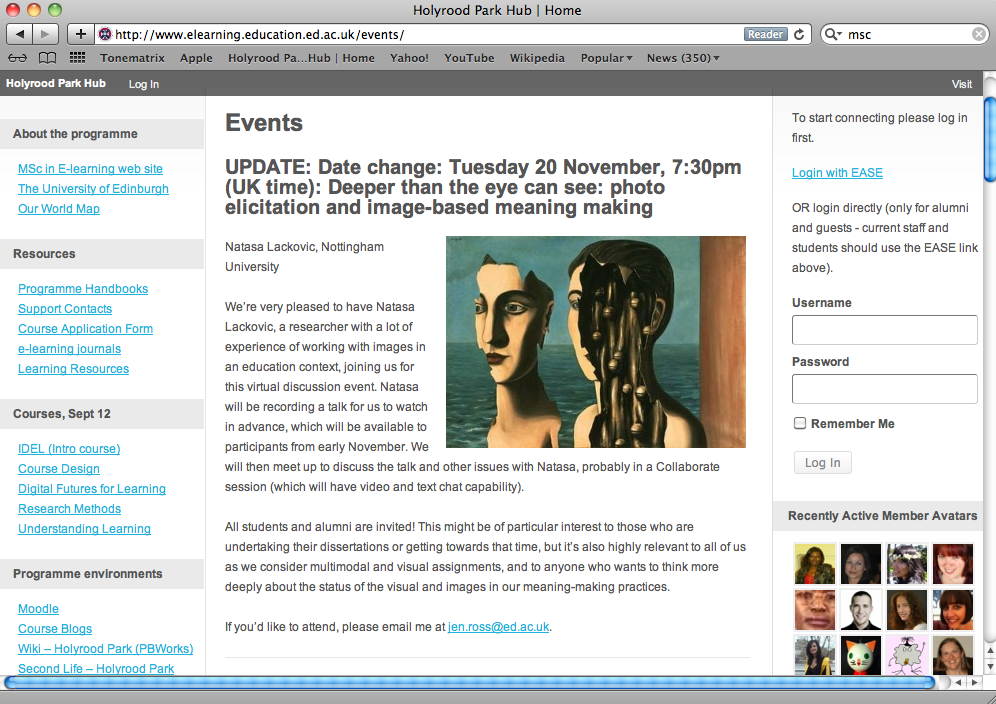
Just noticed this from Sian on Facebook. No time to reflect on it just now so will bookmark it in the form of a screenshot: 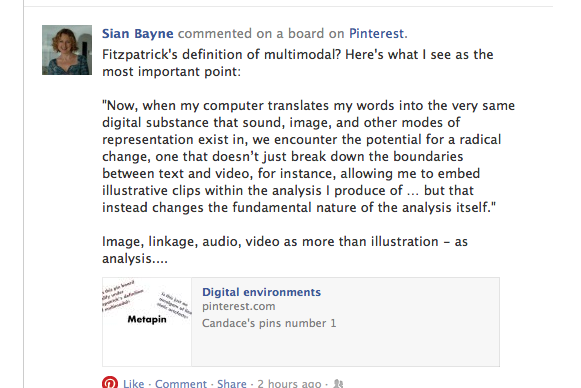 The following information snet through from Jen Ross ahead of Natasa Lackovic's session on visual literacy next Tuesday. The video doesn't play (something to do with Windows Media Player, apparently) so I'll need to try go in early to work and try and catch it before Tuesday.
I'm really glad that I contacted Natasa Lackovic and that I took time to speak to her during her time at Edinburgh University earlier this year. From what I know of Natasa she is a shining star in her field therefore, just as with members of the MSc in E-Learning team and with Michael and Jeremy, I'm going to try to learn as much from her as possible. It was really good then to get a reply to the message that I sent on Friday, including the offer to continue our discussions.
This evening I've replied to Natasa thanking her and taking up her offer of some suggested reading within multimodality. I've also said that I'll get in touch again to discuss my research once it's a bit more formed.
|
Categories
All
Archives
October 2013
Timeline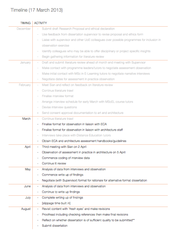
Other stuff
|