DR JAMES LAMB
  • About
  • Publications
  • BLOG
  • About
  • Publications
  • BLOG

Writing up observation at ESALA

7/9/2013

0 Comments

 
I've been thinking about how I could use this. Will there be room for it Witihin the main body of the dissertation? How and where will it fit in, without going over ground that has ready been covered? How much space should be allocated to it?


I could try and be quite imaginative with this. In my head I'd been thinking that this would be text and photographs. There's an opportunity though to do something more interesting. I could make the write up quite an interesting multimodal artefact in itself, as follows:

  • text
  • photos (people, work)
  • some of my own hand written notes/comments where appropriate (photos)
  • my own diagrams sketched during observation e.g. Layout
  • close up photographs of relevant sections of text

Another quite interesting idea...

I could create some form of image (annotated photograph, manipulated photo, my own creation) to demonstrate the different modes being employed. This would almost be a scientific e.g. Medical, biological diagram.

Maybe do this in thinglink: by hovering over different parts of the diagram, text appears naming the mode. THe pop Up text would be a combination of descriptive dialogue interwoven with literature, for instance a direct quote or a 'see for instance Kress 2001'.

A bit like the maps for the NG project, I should take the original photo and do something interesting with it, not least as my own 'people shots' from the observation aren't particularly strong. AS this is in Eca/architecture, maybe I take an artistic or architectural approach to the image. Actually, the idea of architecture is good, although it could cause confusion with the constellation map if it ends up looking like a plan. Maybe just go for something interesting and artistic.

It might be difficult to depict the artwork on a people image therefore maybe i create a composite in PowerPoint, with a 'model and sketches' image inset, which I then import to thinglink to make interactive.

As per the use of videos within this dissertation, I don't want lots of accompanying explanatory text - this implies a lack of faith in the artefact. This image should work as a stand alone, therefore I'll have the smallest amount of text (as part of the wider text) and then have - 'see image' or perhaps not even that.

0 Comments

Sian's paper on Networked Learning with Digital Texts

3/9/2013

0 Comments

 
Another helpful e-mail from Sian:
James - one other thought - did I ever send you my paper on Networked Learning with Digital Texts? It's old now (2006) but you might find it useful. It's also the original source for the idea Ray was mentioning of the crests and the codex book (it was part of my thesis) - he uses that all the time and never credits me : ) I'm not bitter - it's the  supervisor's privilege (be warned!).

the paper's available here: 

http://www.networkedlearningconference.org.uk/past/nlc2006/abstracts/bayne.htm


So there you go! Land's work on crests....was Sian's work.
0 Comments

Sian's response to video idea

3/9/2013

0 Comments

 
A reply from Sian in response to my question about the use of video. I can't disagree with any of the below. Basically, it would be good, but its not necessary, and my priority should be the writing.
Hi James

On the video issue: yes, I can see why you might be tempted by this, and I know you'd do it well. My only concern is the time issue, and that the technical and creative challenge of making them might just eat too much into the overal writing time. You'd be able to make most of the points you mention in the blog via a single video - so you might want to consider just restricting it to one rather than trying to be more ambitious with the three.

I'm pretty confident this is going to be an excellent dissertation: you don't *need* videos to make it so. If you feel the time sacrifice is going to be problematic, you can always think of the videos as something to do later - at the moment I think the main thing is getting the dissertation done in good time to move on to whatever comes next.

One other point is that I'm not sure a video would make the point more 'authentically' - while I know what you're getting at, I think authenticity is a tricky concept when it comes to academic knowledge of any kind. Perhaps it might be more useful to think about making the point more *critically* - and whether video would help you do that?

I hope this is useful - I'm not trying to put the dampers on this, just urging a note of caution.

The video idea was already on hold until I get the writing out of the way, however it has been useful to have this reaffirmed.
0 Comments

Some thoughts on multimodal campus video

3/9/2013

0 Comments

 
I know I'm not supposed to be working on this until the writing is out of the way, however I had half an hour in a cafe over lunch so thought I might as well put it to use. Some thoughts on how the 'campus exploration' video might work:

  • Outside of university entrance. Sound of the outdoors. The door opens, with pseudo effects (but not hackneyed or forced).
  • We've now gone through the corridor. There's the sound of footsteps, possibly echoing. The impression given is of moving down the corridor. This might be by zooming forward or perhaps merging photos - a bit like google maps street view - that progress further down the corridor. There's the distant sound of speaking, through an open or closed door, that gets progressively louder as we move down the corridor.
  • We arrive at a door that says 'architecture crit room'. The door is either open or closed. The sound is louder again.
  • We enter the room and see students participating in an architecture crit exercise. Or perhaps it isn't architecture and is a different area of art. In fact it doesn't need to be a crit room, it could be students producing some other form of multimodal work. Anyway, we can see and hear what they are doing, perhaps across a couple of different photos, perhaps an image that shows students working followed by a close up showing an example of multimodal work for assessment e.g. sketches, model, notepad, photos.
  • We exit the classroom and move out into a different corridor this time. As we make our way along the corridor (signifying a different part of the campus and a different discipline) the sound from the first class fades and instead we begin to hear the sound of music playing. The sound of footsteps is constant, however.
  • Now we enter a studio or music practice room or space. The music is louder now. Across the two images we see a student composing (on sheet music) and then playing music. Or perhaps the other way round, to be consistent with the previous visit i.e. activity/still work. When he is writing, the sound of music is replaced by pen or pencil on paper (or perhaps nothing).
  • We exit the music room and the music gradually begins to fade as we make our way down a third different corridor. Again we hear the sound of footsteps. We begin to the hear the sound of a student speaking in a more formal way. This time we enter a more typical classroom or seminar room where students are delivering a presentation. Across the two images we see the team presenting and then a close up on the computer screen, with PowerPoint slides displaying text and image (or maybe text is enough). Perhaps their cue cards or slides are also in shot, although that's purely aesthetic. They are also communicating through their formal dress and their body language. The content of what they are saying is relevant to the subject of my dissertation and maybe I select the relevant slide from their presentation to feature as the second image.

What follows?

  • It would be nice to have arty style notes included at the end explaining the significance of each scene, for instance that the music student completes Phd assessment without accompanying text. This would be small white type on black background but maybe with a different image from that scene  in the bottom right corner of the screen (almost like end credits). Within this I would refer to specifics i.e. the programme and university, just to show that its real rather than conceptual. I'll have to think about what the background noise would be over the credits - if there's any at all.
  • But why would I go from shots around campus to graphics on a black background? Maybe it would be more interesting to continue with the idea of photos on campus. Maybe I reuse idea from the SWOP video and have them as notices pinned on a board. Although why would this information be pinned on a board? it might though appear on screen. That's it! In each of the venues where I set one of these multimodal scenes, I take an additional image of a computer screen with limited accompanying text displayed. For instance, I would take a photograph of my laptop displaying the explanatory information for the musician, with the musician in the background out of focus. Or maybe just his empty chair and music stand can be seen in the background. And this would the same for the other scenes - an empty lecture theatre with spoiled presentation notes and a references slide. An empty studio space, perhaps no longer with any work on display. In each case the background will be blurred but still identifiable - achieved either using the close up function on my camera or in photoshop. 
  • Do I include a quote from the literature to be a part of each explanation. Hmm, danger of overlapping with the multimodal definition video?
  • Maybe the video ends with the lights being switched off in the final classroom, as used to good effect in the SWOP video. This will be distinct from my final technologies video where I will log off or shut down.


[Lunch ends]
0 Comments

References: multimodal ending

1/9/2013

0 Comments

 
The 'digital tools' video should be included at the end of the Acknowledgements and References section. 

It's appropriate that the ending to the dissertation should be authentically multimodal.

Maybe there's even a way of acknowledging the conclusion of the dissertation with what appears in the video? Maybe something on screen? Maybe I log out. Or the computer shuts down and then the lights go off (with sound) as per the Manifesto video. This would be nice - nothing too forced, though - no 'The End'  or 'That's all folks' kind of thing. 
0 Comments

Abstract on screen

1/9/2013

0 Comments

 
Quickly: the Abstract should be linked from the screen on the front page of the website. 

Or can it appear in full, rather than linked? Not sure that would work particularly well in thinglink. It might work in Padlet, although that has limitations in its own right.

Picture
0 Comments

Text for Methodology

1/9/2013

0 Comments

 
The following text could go in the methodology. It's lifted from an earlier draft of the Introduction:

A semi-narrative approach also encouraged participants to tell their own story of how they had encountered multimodality as students or in other settings, and how this had informed their subsequent practice as tutors. Participants were also invited to discuss how they would approach the assessment of two contrasting multimodal assessment artefacts, having been invited to view the work prior to interview.

0 Comments

Content outline and structure

27/8/2013

0 Comments

 
Before I start writing the content for each component of the website, I will draft the short introductory signpost that goes at the top of each section. 

This will be helpful in enabling me to work out exactly what is going to be included within each section of the dissertation. 

It will also be a useful document to send to Sian for comments.
0 Comments

Contents page and Contents map

27/8/2013

0 Comments

 
[File under Abandoned ideas]

A useful idea this. It came to me a whilst waiting for the audience to arrive for a talk in a high school earlier today. It's funny how, given a fixed and short amount of time, it's possible to come up with some clear and potentially useful ideas.

I think I should have a dedicated Contents page after all. Here's how it will work in relation to the constellation image on the front cover. Bullet points as again, I've got a fixed amount of time to spend on this just now.

  • I think I should have a Contents page, in between the front page Constellation map and the Introduction. I think this would make the thing more user-friendly.
  • The contents page would have a representative icon plus the text that appears at the top of each section page outlining what follows.
  • The page would be portrait (icon:text) however perhaps I could insert some form of constellation line between them for some kind of consistency with the map. Hmm, not sure that would work.
  • What then is the function of the Constellation map? Is there any point in having links to it from different parts of the map. In fact, considering that I'm going for a linear journey through the work, maybe it doesn't sit comfortably with that. Why would someone visit the front page and then jump to the Methodology - that's not how I intend it to be read. 
  • I still like the idea of having some form of representative image as the front page, though.
  • Maybe what I do then is to have the (approximately same) image and, perhaps on the Mac screen, it says 'Click to enter' or 'View contents' or 'Contents' which then leads to the Contents page combined with the 'navigation' information for the site.
  • So the front page would continue as it - with each 'star' representing something, even if it doesn't link or even have a hot point. It would just give the overall impression of 'Image, words and sounds'. I would still though use the circular icons as representative of different sections of the website. 
  • This then destroys the idea of the Constellation line on the front page representing some form of route. And in fact, the links between a Constellation aren't supposed to represent that anyway.
  • This means that I wouldn't be using Thinglink. I would simply need to make the whole image a link. 
  • I probably need to try this out visually to see how it all works.
0 Comments

Chance conversation with Tim Fawns

26/8/2013

0 Comments

 
I bumped into Tim Fawns on the way into work. We had a useful conversation about the difficulty of drawing a piece of research or work to a close. I mentioned that the word count from this blog is far greater than the running total (or limit) for the dissertation. We talked about that. And here am I writing about it, adding further words.

Anyway, some wise words from Tim (in no particular order):

  • it's necessary to have a clear idea of what you're trying to do and to draw things to a close
  • it's not about showing the reader all the things you've read - it's about talking about relevant stuff in an interesting way
  • try not to do too many things or cover too many bases - that makes it harder for the reader. Depth over breadth.
  • a dissertation is not a Phd (and Tim would know as he's done both)

That's helpful.
0 Comments
<<Previous
Forward>>

    Categories

    All
    Abandoned Ideas
    Abstract
    Acknowledge And Bib.
    Actions/things To Do
    Appendix
    Brian Eno
    Carey Jewitt
    Conclusion
    Constellation Map
    Data
    Data Emergent Ideas
    Digital Spaces
    Dissemination
    Dissemination Rationale
    Eca
    Ethics
    Fitzpatrick
    Glossary
    Hypertext Links
    Ideas
    Image
    Interviews
    Kress
    Land
    Literature/reading
    Lit Review
    Meetings
    Methodology
    Music
    Natasa Lackovic
    Observation
    Photography
    Research Proposal
    Sian
    Soundtrack
    Stephen Hunter
    Time Needed For M
    Title
    Uni Crest
    Vectors
    Video
    Visual

    Archives

    October 2013
    September 2013
    August 2013
    July 2013
    June 2013
    May 2013
    April 2013
    March 2013
    February 2013
    January 2013
    December 2012
    November 2012
    October 2012
    September 2012
    August 2012
    July 2012
    June 2012

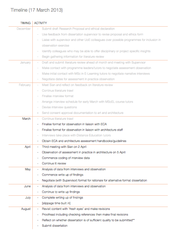
    Timeline

    Picture
    Other stuff
    Resources page
    Moodle
    EDC13
[email protected]