|
On holiday and currently without access to the interview transcripts (or at least, a desire to look through them whilst on holiday and with only small bits of time here and there for study). This is potentially a useful exercise, though: reflecting from memory on what the key themes are to have emerged from the data. Perhaps being apart for the transcripts will help me to identify the most significant themes. Here goes, then:
Actually, I think this has been an interesting exercise. It's interesting that so many ideas stand out considering it's a little while since I looked at the transcripts.
0 Comments
This text is concerned with participant attitudes to retraining and could be included in the data analysis and discussion section.
Across the seven interviews, the most contentious issue was whether a shift towards multimodality and presentation of academic ideas presented in non-traditional forms called for a rethink in how tutors are trained. This area of discussion also prompted the most emotional response. As discussed within the literature review, NAME suggests that [include section here from lit review where two authors talk about a need for retraining or event to rethink the role of the tutor]. Of the seven participants, three responded defensively to the question [detail here followed by an indented quote]. In contrast, amongst some other participants there was an acknowledgement - and in one instance a positive embracing - of the suggestion that tutors involved with assessing digital multimodal assignments might participate in training tailored to such work. It is perhaps significant that participants who accepted the need for additional training had academic or professional backgrounds within the creative arts, including film, ceramics and animation. Those who were most defensive meanwhile had earlier experience of multimodal work in an academic setting. The size of the sample here is too small to draw any meaningful conclusions on whether tutors who have themselves trained and worked in disciplines where text is not the dominant form of expression or representing ideas, are more inclined to accept a need to receive training to contend with student work that looks beyond words on page or screen. Nevertheless, there was an acceptance across participants that experience of multimodality as a student had subsequently informed their approach as tutors.... This could go in the concluding part of my literature review.
To date, critical discussion of multimodality and the related fields of digital literacies and hypertext writing have taken a number of approaches and attended to a range of different areas. This has included the institutional implications of a shift towards digitisation within the academy, the potential implications upon how academic information and ideas are presented and how multimodal texts might be deconstructed or analysed. Less critical attention however has considered the experience of the tutor. With some exceptions, the focus has been upon the institution, the student and the researcher. Within the lit review, rather than talking at great length about the fact that multimodality already exists within the academy - I'll put the message across in a multimodal way.
Within the lit review i will use the phrase 'a wander around the campus...' and will hyperlink to the video. The video - which I've already explore in this blog - will take a multimodal approach to explain what would otherwise seem quite forced and incomplete in words. The video could include a combination of sound, photography and perhaps a few short captions. I would include music, art and a PowerPoint presentation. It would be good to extend this to another subject area within Edinburgh University but time is really tight. Somewhere in the dissertation I should draw attention to all of the digital tools I've used during the dissertation. Actually, this is a section that should sit within the Acknowledgements and Bibliography section.
When I talk about the different tools that are available to students - or perhaps more specifically when I talk about my plans to create original work in the rationale - I would then hyperlink to the different tools I have used myself during the dissertation. During the dissemination rationale I will discuss the idea of originality and discuss whether we should be acknowledging the digital tools and spaces that can significantly influence how we represent our ideas. Just a quick thought on what this might include (and perhaps I would group them by their function or by how I've used them): Photoshop, PowerPoint, Word, Weebly, Sound Studio, Thing link, Bloom. Actually, I should stick to the compositional and representational tools and spaces, not stuff like Dropbox. It makes sense that I should use a Brian Eno app to create the sound in my dissertation website. I've listened to his ambient albums as much as anything whilst I've been working on my dissertation.
Also, the apps created by Eno and Bloom are in themselves multimodal, with their combination of sound and visuals. So I'll use a multimodal app to create the soundtrack for my multimodal dissertation. Maybe it's worth acknowledging this somewhere in the dissertation - probably the combined acknowledgements and bibliography section (which perhaps lends itself to a more interesting title than Acknowledgements and Bibliography). [Since initially writing the notes below I have abandoned the idea of soundtracking particular sections of the website and will instead include soundtracks only for the video components. Nevertheless, in case I have an unlikely change of plan, and also for completeness, I've included my initial thinking on this blog, below]
I don't have the time or ability (I don't think) to create an original piece of music for every section of the dissertation. Here then are the different options: 1. Only create music to accompany the major, lengthy sections. This would be the literature review and the discussion of data. The problem here would be that the other sections might feel a bit incomplete without music. And how wold I justify only having music and sound for some but not other sections? I don't think a lack of time is an acceptable critical justification. 2. I create a long loop of music for all sections In this case, rather than creating a piece of music to match a particular section of the dissertation - and I have no idea how I would create representative music for an appendix, for instance - I would instead create a single piece. Furthermore, it wouldn't be possible to create music that perfectly coincides with particular section of text. So I would Create a single long track that it representative of the wider project rather than a single, specific section of the text. And the winner is.....Option 2. Well done Option 2! So what would this involve and how would it work? This piece would be on a long loop, evolving as it plays so that no two parts of the are identical. Thank you, Brian Eno and Jem Finer. Using one or more sound creation apps, I would create a long loop of music. This might involve creating a series of separate pieces that are then merged together. To that I could add other fragments of sound that I record separately. To give the impression that these are all different pieces of music, there could be a different start place on each page of the site. [Pity I've this idea this idea to the vaults - it was quite a nice solution, I think.] This short section of text will be on a discreet page, linked to from the front page of the website. Perhaps I will link to this using an information icon.
After that I'll briefly explain or discuss the following:
In each case I will use a small icon - for instance a part of a screen shot or an icon - alongside each of the different components above. This will break up the text and make the whole thing more user friendly - a combination of explanation and how to use this site, type of approach.
So, the structure of this section would be:
Am panicking a bit about how I'll write enough by my October deadline. I'm not sure the following will help but here goes. Word count and structure:
17000
This text could appear in the dissemination rationale introduction:
Within this section I offer a rationale for the form taken in representation of information and ideas within this dissertation. It is a requirement of the Dissertation (as outlined in the course dissertation with link) that 'direct citation from the handbook'. For the purpose of my own work however, it is necessary to discard the term 'dissemination', with its emphasis on one way communication of ideas (see for instance the work of //// within the field of Communication Studies), and to look for an alternative way of recognising how the audience is encouraged to interact with the assembled information and ideas. Dissemination promotes a communicational hierarchy between author and reader whether information is sent and received, without provision for responding to what has been received. This hierarchy can be flattened when information is communicated in a digital multimodal way. As /// suggests, digital multimodal texts invite the reader to interact with the presented information. The notion of hierarchical power relations is further depriveliged by the suggestion that the reader of digital texts can be a coauthor of meaning (citation) and she selects her own path through the non-linear assemblage of represented ideas and information (citation). Although my own dissertation proposes a path for the reader, she is nevertheless free to move between the component parts whilst enjoying the freedom to draw her own conclusions about the meaning of the assembled images, sound, video and hyperlinks. Rather than focusing on the dissemination of information, my dissertation is instead concerned with the representation of ideas for the reader to consider... A concluding line needed here to link to title of section - look back at notes from last meeting with Sian. This section meanwhile could follow a little after and pertains to the idea of originality. I like this bit as it brings in the literature in a gentle way: As outlined in the literature review, a key theme within the discussion of multimodality is that digital communicational technology enables the representation of information across a growing range of modes and using an wide range of tools. Within the digital classroom - and in particular programmes that are delivered online - students would seem to have the opportunity to present information in imaginative, original ways, drawing on a growing range of digital tools and spaces. Rather than assuming the accepted form of the conventional essay, the student might take control of the digital means of production to create an artefact that is more inventive and personal in its form than simply rendering words on page or screen. The varied collection of work gathered on the course gallery of the MSc in Digital Education testifies to this, as traditional textual forms sit alongside work composed and dispayed in video, hypertext essay and Second Life: in some cases the work is (virtual) world away from traditional essay. My own dissertation provides an appropriate and useful opportunity to explore whether the form of the artefact can be entirely original: the layout, photography, sound and image are the product of my attempts to exploit digital tools my disposal (a list of which can be viewed in the acknowledgements section). Admittedly, while I am responsible for the assemblage of words, I am cannot claim responsibility for their meaning (even if someone says that words are empty vessels). Similarly, while the choice of type is my own, I did not design the typeface, although even that is possible for the student with sufficient digital design schools and accompanying time. Similarly, although I have created the structure and layout of this website, I didn't author the code, although again, a more technically able student would be able to do so. |
Categories
All
Archives
October 2013
Timeline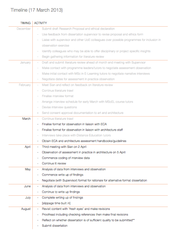
Other stuff
|